Promo code APP3 – € 3 discount on your first order in app
  Free delivery for orders over € 49


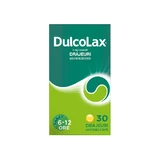
DULCOLAXO BISACODYL 5 MG 30 GASTRORESISTANT TABLETS
Description
ACTION AND MECHANISM
- Laxative. Bisacodyl is a stimulant laxative derived from diphenylmethane. It works by stimulating colonic peristalsis through direct action on the mucosa or on Auerbach's myenteric plexuses. It produces an accumulation of fluids and electrolytes in the intestinal lumen. The onset of action occurs within 6-10 hours when administered orally, or 15-60 minutes when administered rectally.
SPECIAL WARNINGS
- Perform a differential diagnosis in patients suspected of having intestinal obstruction.
- Before starting treatment, the patient must be adequately hydrated and have normal electrolyte levels. Treatment should not be started if these levels are abnormal.
- In elderly or debilitated patients, periodic monitoring of electrolyte levels is recommended.
SENIORS
Peristalsis stimulants may exacerbate weakness, incoordination, and orthostatic hypotension in geriatric patients, resulting from extensive electrolyte loss, when used repeatedly.
PATIENT ADVICE
- Before starting treatment for constipation, lifestyle changes should be made. It is recommended to maintain an adequate daily intake of fluids and fiber, respond quickly to the urge to defecate, and exercise.
- This medicine should not be used by patients with intestinal obstructions.
- Continued use may cause habituation.
- If after 1 week of use, constipation does not improve, persists, or worsens, consult your doctor or pharmacist.
- Consult your doctor and/or pharmacist if constipation worsens, or if symptoms such as nausea or vomiting, abdominal swelling, or fever occur.
CONTRAINDICATIONS
- Hypersensitivity to any component of the medication.
- Situations that could be aggravated by the laxative effect, such as [INTESTINAL OBSTRUCTION], [INTESTINAL PERFORATION], chronic [INFLAMMATORY BOWEL DISEASE], [APPENDICITIS] or [TOXIC MEGACOLON]. Logically, it should not be used in patients with [DIARRHEA].
- [DIGESTIVE HEMORRHAGE]. Bisacodyl should not be administered to patients with gastrointestinal bleeding due to its irritating effects on the intestinal mucosa.
PREGNANCY
FDA Category B. Considered safe when used alone.
PHARMACOKINETICS
Oral route:
It is a prodrug that is metabolized in the colon by the action of bacterial flora, giving rise to the active metabolite, bis-(para-hydroxyphenyl)-2-pyridylmethane.
- Absorption. Very small amounts are absorbed.
Food: Milk can increase the absorption of bisacodyl, so it is recommended to separate milk and bisacodyl intake by at least two hours.
- Metabolism. The absorbed portion is metabolized in the liver by conjugation reactions.
- Excretion. Unabsorbed bisacodyl is excreted in the feces, while the small absorbed fraction is eliminated in urine.
INDICATIONS
- Symptomatic treatment of temporary [CONSTIPATION], such as that caused by prolonged bed rest or travel.
INTERACTIONS
- Digoxin. Prolonged use of laxatives can lead to potassium depletion, increasing digoxin toxicity. Monitoring electrolyte levels is recommended in patients receiving digoxin.
LACTATION
Neither the active moiety of bisacodyl (bis-(p-hydroxyphenyl)-pyridyl-2-methane) nor its glucuronides are excreted in breast milk. Acceptable use during lactation.
CHILDREN
As a general rule, laxatives are not recommended for children under 6 years of age, as they are often unable to accurately describe their symptoms. A proper diagnosis should be made before using a laxative, as it could mask more serious symptoms. The labeling approves the use of the tablets for children over 2 years of age.
RULES FOR CORRECT ADMINISTRATION
The tablets should be taken whole, without chewing, at night, with a small amount of liquid other than milk (See Interactions). They should not be taken with products that reduce acidity, such as milk, antacids, or proton pump inhibitors, to prevent premature dissolution of the enteric coating.
POSOLOGY
Oral administration:
- Adults: 5-10 mg/24 hours.
- Children:
* Children > 10 years: 5-10 mg/24 hours.
* Children 2-10 years: 5 mg/24 hours.
* Children < 2 years: contraindicated.
PRECAUTIONS
- Symptoms of intestinal obstruction. Before starting treatment with a laxative, a differential diagnosis of intestinal obstruction is recommended in patients with symptoms such as [NAUSEA], [VOMITING], or [ABDOMINAL PAIN] of unknown origin, or [ABDOMINAL DISTENSION].
- [Electrolyte IMBALANCE]. The use of laxatives for long periods of time may result in electrolyte imbalance. Patients should be adequately hydrated and have normal electrolyte levels before starting treatment with a laxative.
- Dependence. Continued use of laxatives can lead to dependence, as they may cause electrolyte imbalances that cause intestinal atony.
- Dizziness/syncope: Dizziness and/or syncope have been reported and appear to be attributable to distension caused by stool or as a vasovagal response to abdominal pain associated with constipation, and not necessarily to the administration of bisacodyl itself.
PRECAUTIONS RELATED TO EXCIPIENTS
- This medicine contains lactose. Patients with hereditary [LACTOSE INTOLERANCE] or galactose intolerance, the Lapp lactase deficiency, or glucose-galactose malabsorption should not take this medicine.
ADVERSE REACTIONS
The adverse effects of bisacodyl are generally mild and transient. The most common adverse reactions are:
- Digestive. [ABDOMINAL PAIN] and [ABDOMINAL DISTENSION] may occur after continued use. Rectal forms may also cause irritation, pain, and bleeding of the rectal mucosa, and in more severe cases, [PROCTITIS].
Hematochezia (passage of bloody stools) has been observed, which is generally mild and self-limiting.
- Allergic/dermatological: [EXANTHEMATOUS ERUPTIONS] and hypersensitivity reactions including [ANGIOEDEMA] and [ANAPHYLAXIS] are very rare.
- Metabolism and nutrition: [DEHYDRATION].
ADVERSE REACTIONS RELATED TO EXCIPIENTS
- Because it contains castor oil, it can cause stomach upset and [DIARRHEA].
OVERDOSE
Symptoms: Following excessive administration, a condition characterized by gastrointestinal spasms, mucous and diarrheal stools, and loss of potassium and other electrolytes may occur.
Treatment: The laxative should be discontinued. Supportive care should be initiated, with rehydration with saline solution and mineral salts if necessary. Antispasmodics may be administered to relieve intestinal spasms.
COMPOSITION
BISACODYL: 5 MILLIGRAMS
LACTOSE (EXCIPIENT): 34.9 MILLIGRAMS - MONOHYDRATE
SUCROSE (EXCIPIENT): 23.38 MILLIGRAMS
CASTOR OIL (EXCIPIENT): 0.98 MILLIGRAMS
Features
| Product code | 508191 |
| Category | Meteorism, Digestive Diseases |
| Product line | Dulcolax |
| Brand | Sanofi |
| Quantity | 30 |
| Delivery from | Spain |
DULCOLAXO BISACODYL 5 MG 30 GASTRORESISTANT TABLETS
DULCOLAXO BISACODYL 5 MG 30 GASTRORESISTANT TABLETS
Delivery from Spain


Leave your email, and we’ll let you know as soon as it’s back in stock!
Recently viewed products













Reviews

DULCOLAXO BISACODYL 5 MG 30 GASTRORESISTANT TABLETS
 Earn € 1 Reward for every review
- For each submitted and approved review you can earn € 1 Reward on your Rewards Credit.
- Rewards are given once for each purchased product you have reviewed.
- You have to be authorised to receive Rewards
All reviews

There are no reviews for this product.












 Description