Promo code APP3 – € 3 discount on your first order in app
  Free delivery for orders over € 49


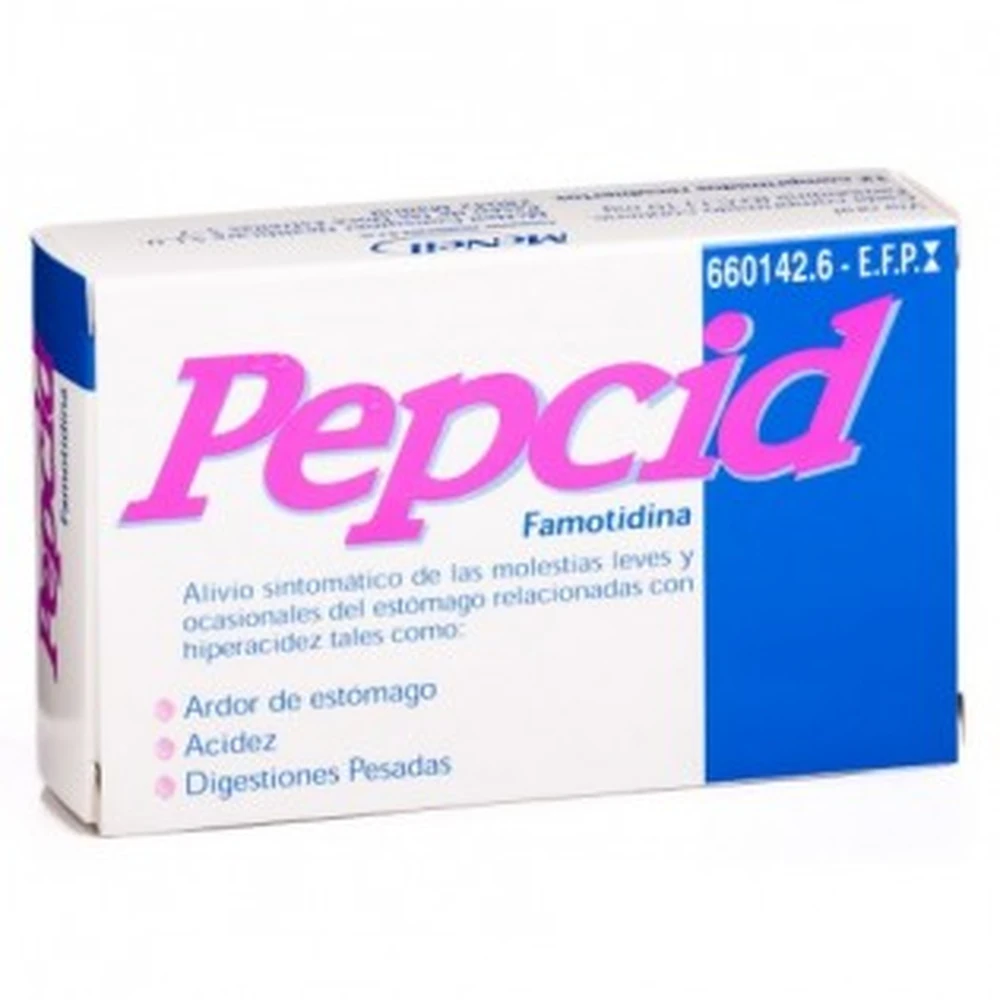
PEPCID 10 MG 12 COATED TABLETS
Description
ACTION AND MECHANISM
- [ANTI-PEPTIC ULCER], [ANTISECRETORY GASTRIC], [HISTAMINERGIC ANTAGONIST (H-2)]. Famotidine is a histaminergic analogue in which the imidazole ring is replaced by a guanidinothiazole ring. It acts as a specific, competitive and reversible antagonist of the histamine H2 receptors located in the gastric parietal cells. These receptors, when stimulated, activate an adenylate cyclase, producing an increase in cAMP levels, which, by a cascade mechanism involving the phosphorylation of different proteins, activates the proton pump and therefore gastric acid secretion. It does not decrease pepsinogen production, although it reduces pepsin activation when gastric pH increases. On the other hand, it slightly stimulates mucus production. Its effects are not additive after repeated dosing. It is a highly specific antagonist and does not affect H1 receptors or exhibit anticholinergic effects. Famotidine inhibits basal gastric secretion, that stimulated by caffeine, histamine, gastrin, cholinergic agonists, food, insulin, and nocturnal secretion. It does not affect gastric emptying or lower esophageal sphincter pressure. Famotidine is 40-60 times more potent than cimetidine, and 4-5 times more potent than ranitidine, ebrotidine, or nizatidine, although this wide difference does not imply any therapeutic benefit, only the need for a lower dose.
SPECIAL WARNINGS
- If the patient experiences symptoms such as dyspepsia, dysphagia, a feeling of fullness, symptoms of gastric bleeding, such as melena, hematemesis or anemia, or unexplained weight loss, the existence of esophageal or gastric carcinoma should be ruled out before administering this medication.
SENIORS
No specific problems have been described in elderly patients that would require dosage adjustment due to age. However, it should be noted that decreased renal function is common in patients over 65 years of age, and in this situation, dosage adjustment may be necessary (see Dosage in Renal Impairment).
PATIENT ADVICE
- Do not take for more than 1 week without the consent of your doctor or pharmacist. - The maximum recommended dose is 20 mg/day (2 tablets/day). - Consult your doctor if symptoms persist or worsen after 1-2 weeks, especially if you report symptoms such as feeling full, weakness, or unexplained weight loss.
CONTRAINDICATIONS
- Hypersensitivity to famotidine, as well as to any other H2 antihistamine, since cross-hypersensitivity reactions have been described.
EFFECTS ON DRIVING
Famotidine does not appear to substantially affect driving, but it should be noted that it may cause dizziness.
PREGNANCY
FDA Category B.
Animal safety: No cases of teratogenicity with famotidine have been reported in animal trials. Administration of doses of 250 MRHD to rabbits resulted in an increased incidence of abortion.
Human Safety: Famotidine crosses the placenta. Adequate and well-controlled human studies are lacking. Retrospective studies of women receiving H2 blockers during pregnancy did not show an increased risk of birth defects, miscarriage, or low birth weight.
Its administration is only accepted if there are no safer therapeutic alternatives, and the benefits outweigh the possible risks.
Effects on fertility: No specific studies have been conducted on its effects on fertility.
PHARMACOKINETICS
Oral, intravenous:
Pharmacokinetics are linear over the therapeutic dose range:
- Absorption: Rapid and incomplete oral absorption with minimal first-pass hepatic absorption. Doses of 20 and 40 mg (po) result in cmax of 29-33 and 76-104 mcg/ml, respectively, with a tmax of 1-3.5 h and a bioavailability of 40-50%.
The effects appear after 1.5 h (po) and are maximal at 3 h (po) or 30 min (im). The effect lasts 10–12 h.
Effect of food: does not significantly affect absorption.
- Distribution: Rapid distribution throughout the body, with a t1/2 of distribution of 0.18–0.5 h and a Vd of 0.94–2 L/kg. Low plasma protein binding (15–30%). Famotidine crosses the BBB in small amounts (CSF concentration 0.01 mcg/ml).
- Metabolism: partial in the liver (30-35%), giving rise to famotidine sulfoxide, without pharmacological activity.
Enzyme-inducing/inhibiting capacity: it does not present significant inhibitory or inducing activity of hepatic enzyme systems.
- Excretion: mainly in urine (65-70%; 25-30% unchanged). The CLr is 250-450 ml/min, indicating some active tubular secretion. The elimination half-life is 2.6-4 h.
Pharmacokinetics in special situations:
- Children: Pharmacokinetics have not been determined in children.
- Elderly: In elderly patients, a decrease in famotidine elimination may occur, although the effect may be due more to reduced renal function than to the individual's age.
- Renal insufficiency: due to its renal elimination, famotidine tends to accumulate in patients with renal insufficiency, with increases in t1/2 of up to 11.7 h (CLcr 10-30 ml/min), 20 h (CLcr < 30 ml/min) and even greater than 24 h (anuric patients) having been described.
- Liver failure: no significant pharmacokinetic differences have been found in cirrhotic patients.
INDICATIONS
- [GASTRIC HYPERACIDITY]. Symptomatic treatment of heartburn in adults and adolescents over 16 years of age.
INTERACTIONS
- Drugs with pH-dependent absorption. The increase in pH produced by antiulcer drugs could modify the absorption of certain medications by promoting or reducing their dissolution in the aqueous medium of the gastric contents. Thus, an increase in the absorption of digoxin has been observed, as well as a reduction in that of azole antifungals (itraconazole, ketoconazole), cyclosporine, mycophenolate mofetil, rilpivirine, vitamin B12, and tyrosine kinase inhibitors (dasatinib, erlotinib, gefitinib, lapatinib, nilotinib, pazopanib).
Digoxin toxicity is rare, but due to its serious effects, caution is advised in elderly patients treated with high doses. Monitoring plasma digoxin levels is recommended.
LACTATION
Famotidine is excreted in milk. However, the potential consequences for the nursing infant are unknown. It is recommended to discontinue breastfeeding or avoid its administration.
CHILDREN
Safety and efficacy have not been evaluated in children and adolescents under 18 years of age, so it is recommended to avoid its use.
RULES FOR CORRECT ADMINISTRATION
Swallow the tablet whole with a glass of water.
POSOLOGY
- Adults and adolescents over 16 years of age, oral: 10 mg when symptoms appear or 1 hour before eating. Maximum dose 20 mg/24 h. Maximum treatment duration 7 days.
- Children under 16 years, oral: safety and efficacy have not been evaluated.
Administration with food: Can be taken with or without food. If symptoms associated with food intake occur, take 1 hour before a meal.
Missed dose: do not double the next dose.
DOSAGE IN LIVER FAILURE
No specific dosage recommendations have been made. Use with caution.
DOSAGE IN KIDNEY FAILURE
- Mild renal impairment (CLcr 50-90 ml/min): no dosage adjustment required.
- Moderate to severe renal impairment (CLcr < 50 ml/min): reduce the daily dose by 50% or increase the interval between doses to 36-48 h depending on the clinical response.
PRECAUTIONS
- [RENAL INFECTION]. Due to its urinary excretion, famotidine may accumulate in patients with renal impairment. Neurological adverse reactions have also been reported in these patients. A reduction in the daily dose or an increase in the interval between doses may be necessary in patients with moderate to severe renal impairment (CLcr < 50 ml/min) (see Dosage in Renal Impairment).
- [LIVER FAILURE]. Although its hepatic metabolism is limited, it is advisable to use it with caution due to limited clinical experience.
- [DIGESTIVE INFECTIONS]. The increase in gastric pH produced by antiulcer agents may promote colonization of the digestive tract by certain pathogenic microorganisms, such as Salmonella, Campylobacter, and even Clostridium difficile in hospitalized patients. A differential diagnosis of [PSEUDOMEMBRANOUS COLITIS] is recommended in patients treated with an antiulcer agent who develop severe diarrhea.
- Long-term treatment. Antiulcer drugs eliminate symptoms associated with acid disorders, which are common in malignant conditions such as stomach cancer or esophageal cancer. Therefore, there is a risk of delaying the diagnosis of these conditions.
It is recommended that patients receiving prolonged treatment, lasting more than one year, undergo regular monitoring and be advised to report the presence of other symptoms associated with these neoplasms, such as significant and unexplained weight loss, recurrent vomiting, dysphagia, or vomiting blood or stool. If a serious digestive process is suspected, a differential diagnosis is recommended.
Similarly, patients receiving on-demand treatment should be instructed to report any changes in their symptoms.
- [VITAMIN B12 DEFICIENCY]. The increase in pH produced by antiulcer drugs could decrease the absorption of cyanocobalamin, so it is recommended to take this into account in people with low stores of this vitamin, such as in patients with [MALNUTRITION] or strict vegetarian diets without supplementation of this vitamin, or situations in which its absorption could be reduced, such as [CHRONIC ALCOHOLISM], [MALABSORPTION SYNDROME] or situations that could lead to malabsorption, such as [INFLAMMATORY BOWEL DISEASE] or major surgical procedures of the digestive system.
- Analytical interferences. The increase in gastric pH induced by antiulcer drugs may increase plasma levels of gastrin (which usually return to baseline within 4 weeks of discontinuing treatment) and chromogranin A (CgA).
CgA is a specific marker for neuroendocrine tumors, so antiulcer agents may cause false positives when used in diagnostic tests. Therefore, any antiulcer agent should be discontinued at least 5 days before CgA testing. If CgA levels have not normalized within this period, the test should be repeated 14 days after discontinuing the antiulcer agent.
ADVERSE REACTIONS
Famotidine is generally well tolerated. Its adverse reactions are mild and occur very rarely, but have led to treatment discontinuation in up to 14% of patients.
Adverse reactions are described according to each frequency interval, considering very frequent (>10%), frequent (1-10%), unfrequent (0.1-1%), rare (0.01-0.1%), very rare (<0.01%) or of unknown frequency (cannot be estimated from the available data).
- Digestive: common: [DIARRHEA], [CONSTIPATION]; uncommon: [NAUSEA] and [VOMITING], [ABDOMINAL DISTENTION], [DRY MOUTH], [FLATULENCE].
- Liver: rare: [CHOLESTATIC JAUNDICE]; very rare: [ELEVATED TRANSAMINASES].
- Neurological/psychological: common: [HEADACHE], [DIZZINESS]; uncommon: [DEPRESSION], [ANXIETY], [AGITATION], [CONFUSION], [HALLUCINATIONS].
- Dermatological: uncommon: [EXANTHEMATOUS RASHES], [PRURITUS]; rare: [ANGIOEDEMA], [URTICARIA]; very rare: [TOXIC EPIDERMAL NECROLYSIS], [ALOPECIA].
- Allergic: rare: [ANAPHYLAXIA].
- Osteomuscular: infrequent: [OSTEOMUSCULAR PAIN], [MUSCLE CRAMPS].
- Metabolic: infrequent: [ANOREXIA].
- General: infrequent: [ASTHENIA].
OVERDOSE
Symptoms: Very limited experience. Doses of up to 800 mg/24 h have been administered for more than a year in patients with Zollinger-Ellison syndrome, without any particularly significant adverse reactions.
Treatment:
- Antidote: There is no specific antidote.
- General elimination measures: if deemed necessary, induce vomiting and/or gastric lavage within 2 hours of ingestion.
- Medication: symptomatic treatment.
COMPOSITION
FAMOTIDINE: 10 MILLIGRAMS
CORN STARCH (EXCIPIENT): 94.1 MILLIGRAMS - PREGELATINIZED
Features
| Product code | 506605 |
| Category | Meteorism, Digestive Diseases |
| Quantity | 12 |
| Delivery from | Spain |
PEPCID 10 MG 12 COATED TABLETS
PEPCID 10 MG 12 COATED TABLETS
Delivery from Spain


Leave your email, and we’ll let you know as soon as it’s back in stock!
Recently viewed products







Reviews

PEPCID 10 MG 12 COATED TABLETS
 Earn € 1 Reward for every review
- For each submitted and approved review you can earn € 1 Reward on your Rewards Credit.
- Rewards are given once for each purchased product you have reviewed.
- You have to be authorised to receive Rewards
All reviews

There are no reviews for this product.











 Description